Phoenix summer monsoons dump isolated deluges across Maricopa County between late June and late September, triggering mass emergence events of dormant floodwater mosquitoes in 5 to 7 days. In low-elevation drainage…
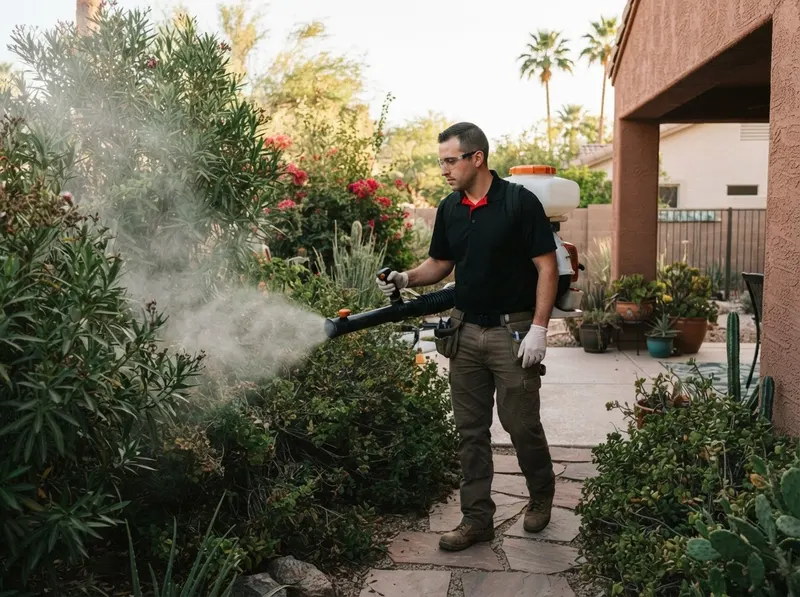
Phoenix summer monsoons dump isolated deluges across Maricopa County between late June and late September, triggering mass emergence events of dormant floodwater mosquitoes in 5 to 7 days. In low-elevation drainage zones like Maryvale and Alhambra, or mature-canopy pockets across Arcadia and the Biltmore Area, water collects in retention basins, sunken citrus planters, and unsealed landscape drains. These microclimates allow Culex species to cycle from egg to biting adult in under a week when soil temperatures exceed 100 degrees Fahrenheit. Halvoro Pest Patrol deploys a dual-action approach: an organic, insect growth regulator (IGR) briquette submerged into pooling storm runoff to stop pupal development, paired with a directional, botanical-synthetic perimeter mist across dense oleanders, shade structures, and foundation weep screeds.
Selecting targeted barrier fogging over continuous automatic misting systems eliminates the mechanical failures and nozzle blockages caused by Phoenix hard water and ambient 115-degree heat. Automatic mist lines release uncalibrated pyrethroids regardless of wind speed, running the risk of non-target drift into Desert Botanical Garden flora or native pollinator corridors. Halvoro Pest Patrol utilizes targeted backpack cold-fog atomizers, placing droplets precisely between 20 and 50 microns onto the undersides of leaves where adult mosquitoes roost during peak daytime heat. If a property features steep wash topography, such as parcels bordering the Ahwatukee Foothills or Camelback Mountain runoff washes, technicians focus heavily on subterranean utility trenches and rock rip-rap where humidity remains trapped long after surface puddles dry.
Every field treatment complies with standards mandated by the Pest Management Division of the Arizona Department of Agriculture. Properties in North Central Phoenix, Willo Historic District, and Norterra require distinct application footprints. For example, flood-irrigated residential parcels in North Central Phoenix sustain soil moisture 72 hours longer than desert-landscaped yards in Desert Ridge, requiring higher concentrations of microencapsulated formulations that withstand repeated hydration. Step 1: Technicians survey the entire property boundary, identifying covert standing reservoirs like blocked irrigation boxes and patio drain sumps. Step 2: Standing water receives microbial Bacillus thuringiensis israelensis (BTI) rings that specifically target mosquito larvae without affecting domestic pets or backyard avian species. Step 3: Mechanical foliage fogging creates a defensive shield up to a height of 10 feet, breaking the reproductive cycle across your exterior living zone.
Every job gets a firm, written price after a free on-site visit.
Tell us about your monsoon mosquito barrier fogging job in Phoenix and we'll send a clear, written quote, usually the same day.
 Halvoro Pest Patrol